
Is it okay to shut down a server just because its CPU usage is low?
We do not shut down servers simply because CPU utilization is low. First, you must determine what operations are involved, when they are needed, and who is authorized to make that determination. A low utilization rate serves as a starting point for the investigation.
What official sources should I consult?
ENERGY STAR recommends compiling a list of servers that includes equipment type, location, associated workloads, and service level agreements (SLAs), and periodically reviewing the usage status and the list. It suggests that very low CPU utilization or network connectivity status can serve as clues for identifying candidates for decommissioning. It is not a metric that automatically concludes that a workload is unnecessary.
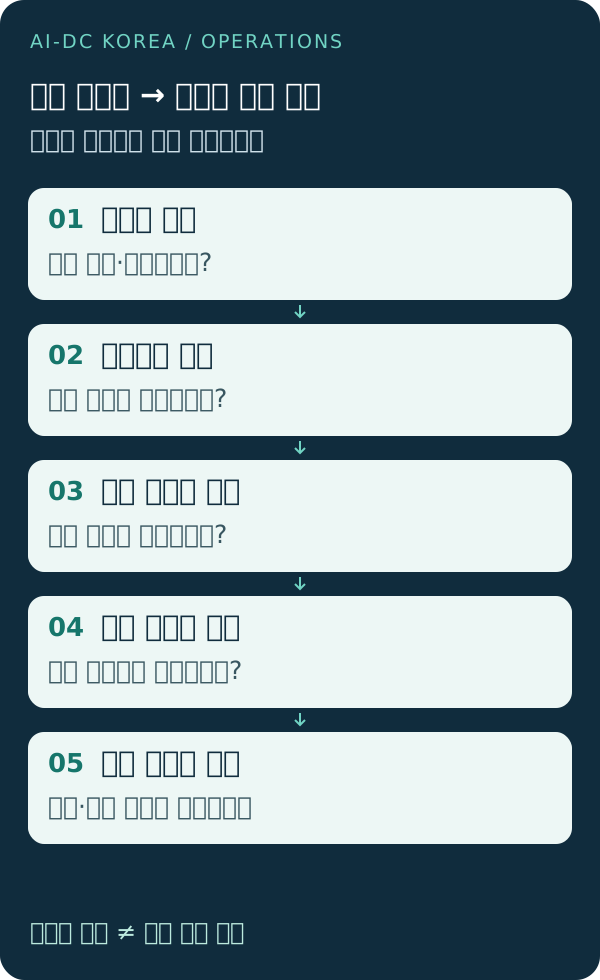
Operational checklist to be forwarded to the person in charge
The following was prepared by AI-DC KOREA: Example of a Review LogThis is not the result of an investigation into actual customer systems or an order to shut down servers.
| Items to Verify | Information to be recorded |
|---|---|
| Equipment Identification | Verification of whether equipment identifiers, locations, and associated operational and management lists match |
| Person in Charge | Service Manager, Equipment Manager, Review and Approval Manager |
| Observation Period | Measurement start and end dates, collection intervals, and periods with missing measurements |
| Scheduled Maintenance | Times of unusual usage, such as month-end, settlement, backup, and recovery tests |
| Dependent Services | Connected applications, authentication, backup, and standby roles, along with supporting evidence |
| Business Requirements | Service Level Agreements, Outage Impact, and Data Retention and Recovery Conditions |
| Check the following | Unconfirmed items, person responsible for verification, scheduled review date |
Do not change the blank to “Unused.”
For example, if a piece of equipment is used for month-end settlement, it is difficult to assess its role based solely on low utilization rates over a few weekdays. Whether it serves as a standby unit for backup recovery or during outages is also something that should be confirmed with the person in charge. This is an assumption made to explain the review context and is not a fact confirmed for any specific piece of equipment.
- If you were unable to locate the person in charge, Needs to be verified by the person in chargeI’ll leave it as is.
- If there is no measurement data, UnmeasuredIndicate as such. Do not fill in missing values with 0%.
- Even if a low utilization rate was observed, if the operational cycle was not taken into account, Refining the Scope of ObservationWrite it as follows.
- Once the functions and dependencies have been organized, provide supporting evidence. Request for Review of ChangesI’ll move on to that.
What happens next once the survey is complete?
Business owners continue to verify the necessary roles and service impacts, while equipment managers confirm dependencies and recovery methods. Change approval officers determine whether to suspend, transfer, reuse, or dispose of equipment, as well as the schedule, in accordance with organizational procedures. Before execution, they document the conditions for rollback, data retention criteria, and post-operation verification methods.
Servers are not shut down simply by filling out a checklist. Nor are energy savings from overseas cases applied as the savings for a single piece of domestic equipment. To review costs, you must separately verify the actual measurements, operating schedules, and contract terms for the specific equipment in question.
Frequently Asked Questions
At what percentage of CPU usage is it considered idle?
This guide does not provide numerical standards applicable to all operations. Please also verify the observation period, operational cycle, standby and recovery roles, and service requirements.
Would it be helpful just to compile a list?
Leaving the contact person and any unconfirmed items in the same table allows the next reviewer to easily identify what needs further verification. Compiling the list and approving actual operational changes are separate steps.
Please organize the materials and questions to be reviewed.
You can begin a consultation by providing links to publicly available data, the reference date, and any unverified items. The scope and process of the consultation will be confirmed after your inquiry. KakaoTalk Consultation: Daily 9:00 AM–6:00 PM. Simply opening the chat window does not constitute a submitted inquiry.