
Does “free cooling” mean it doesn’t use electricity? Guidelines for interpreting outdoor air cooling
This guide explains how to understand air-side economizers and verify outdoor air conditions, temperature and humidity, filters, and operating modes. It does not guarantee zero power consumption or specific energy savings.
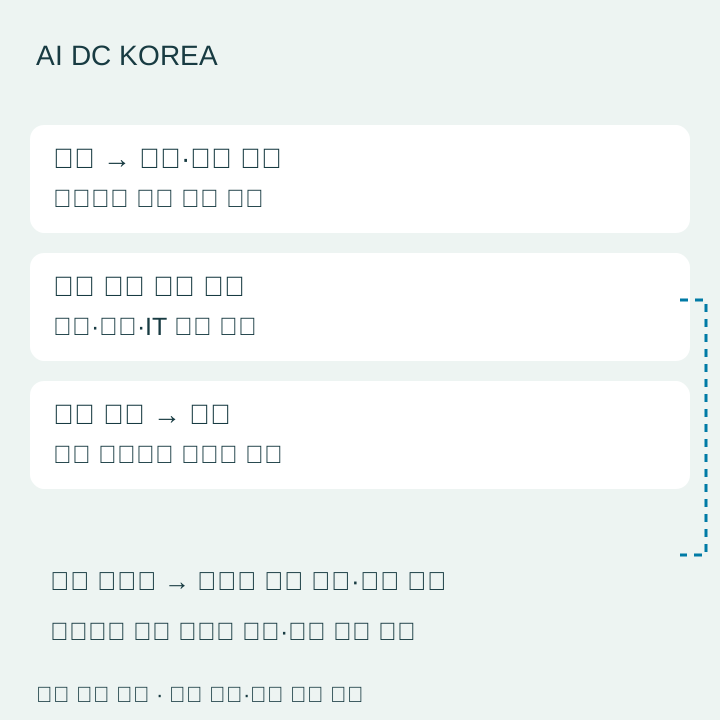
The scope of what “free cooling” refers to
Outdoor air cooling is a method that uses outside air to dissipate heat from a data center. ENERGY STAR describes an air-side economizer, which draws in cool outside air and exhausts hot air under appropriate conditions to reduce the use of mechanical cooling. The term “free cooling” should not be interpreted as a guarantee that the entire facility consumes no electricity.
Three answers to find in the manual
When reviewing the installation manual, write down three questions. First, under what outdoor air conditions does the system operate? Second, how are the temperature and humidity required by the servers maintained? Third, how are particles and contaminants in the incoming air managed? Official descriptions typically include methods such as mixing very cold air with exhaust air to regulate conditions, as well as filters and air-handling equipment.
Table comparing operating conditions
You can create your own comparison table based on “Permitted Operating Conditions / Switching to Mechanical Cooling / Filter Inspection / Operational Records.” If a supplier’s proposal includes annual operating hours, request details on which region’s weather data was used and for what period, as well as the server load and operating conditions. Time-based figures that lack specific location and condition details are difficult to apply directly to other sites.
Regional impacts will be reviewed separately.
This article serves as a guide to understanding facility concepts. It does not calculate applicable time frames or energy savings for specific regions in Korea. Do not determine the effectiveness of implementation based solely on the fact that the outside air is cold; instead, compare it with the operational tolerance range and the results of on-site design reviews.
Table to use when writing directly
| Comparison Criteria | Basis for the request |
|---|---|
| Outdoor Air Permissible Conditions | Region, Weather Data, Time Period, Permissible Temperature and Humidity |
| Conversion Conditions | Mechanical Cooling and Switching/Parallel Operation Standards |
| Filters and Checks | Pollutant Management and Inspection Requirements |
| Operational History | Power, including IT loads and auxiliary equipment |
In-house training and record-keeping forms. Distinguish between hypothetical examples and actual verified values; unverified values are not zero.
If you have prepared your materials, please begin your consultation.
Please provide links to public data, reference dates, and any questions you may have. KakaoTalk support is available daily from 9:00 AM to 6:00 PM. Please note that opening the chat window is different from actually submitting an inquiry.